The Human Story by James C. Davis
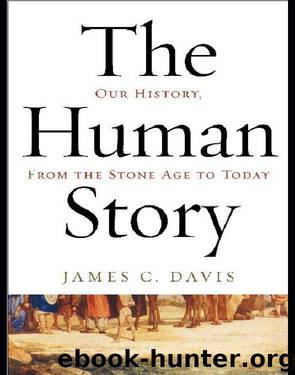
Author:James C. Davis
Language: eng
Format: mobi, epub
ISBN: 9780061745683
Publisher: HarperCollins
Published: 2004-03-26T21:00:00+00:00
EVERYWHERE THE PROBLEM was the same: how could people produce more, so that everyone could have more? The answer was industrialization.
This lengthy word means, simply, raising your output by using aids to production. One of these aids, of course, is machines. Another is the use of power sources that have many times the strength of humans. We used to use the force of rushing streams to run machines for grinding flour, making lint for paper, or working bellows in an iron mill. Later on we used the power of steam, and later still electricity.
Other aids to production have to do with how the work is planned—that is, with organizing workers so that they produce the biggest output possible. The use of all these things—machines, and power, and organization—multiplies by many times the work one does without them.
The first country in the world to have an industrial revolution was England. Why England? One important reason is quite clear. In the 1700s the English, isolated from the wars of the continent, were prospering, and their number was rising. That increase caused a strong demand for basic goods, and manufacturers and inventors saw their chance.
It was in the textile trade that they moved the fastest, and there John Kay began it all. Before Kay’s time a weaver, working on a loom at home, made woolen cloth with considerable effort. He “threw” a wooden shuttle that held a thread back and forth and in and out between two sets of lengthwise threads. In the 1730s Kay made the weaver’s work much easier. With Kay’s improved loom, the weaver, by simply pulling strings, worked two hammers that drove a “flying shuttle” back and forth on grooves. He wove much faster than before, and made a wider bolt of cloth. (However, weavers didn’t like Kay’s new machines at first because they feared the things would put them out of work. They were so hostile to Kay that he fled one textile city hidden in a woolsack.)
Kay’s shuttles made more cloth, but they also raised a problem: his hungry looms required more thread. At this time a spinner made one thread at a time by twisting one fiber to another. But now the spinners couldn’t keep up with Kay’s productive looms; they couldn’t spin as fast as weavers wove. James Hargreaves, a poor, uneducated spinner and weaver, solved the problem. In about 1764 he invented a machine he named a jenny (for his little daughter, who had accidentally given him the idea for it). With this device the spinner turned a wheel that wound thread onto sixteen spindles at once.
However, one man’s muscles weren’t enough if you wished to add even more rods and spin more threads. What cloth-making needed now was another source of power to run the jennies harder. Richard Arkwright, a barber, wig-maker, and business genius, invented a solution, or, more likely, stole it from another man. The key was using rivers as a source of power. He began to make machines, called “water frames,” that did what workers up to then had done by hand.
Download
This site does not store any files on its server. We only index and link to content provided by other sites. Please contact the content providers to delete copyright contents if any and email us, we'll remove relevant links or contents immediately.
| Africa | Americas |
| Arctic & Antarctica | Asia |
| Australia & Oceania | Europe |
| Middle East | Russia |
| United States | World |
| Ancient Civilizations | Military |
| Historical Study & Educational Resources |
Underground: A Human History of the Worlds Beneath Our Feet by Will Hunt(12097)
Sapiens by Yuval Noah Harari(5370)
Navigation and Map Reading by K Andrew(5156)
The Sympathizer by Viet Thanh Nguyen(4390)
Barron's AP Biology by Goldberg M.S. Deborah T(4150)
5 Steps to a 5 AP U.S. History, 2010-2011 Edition (5 Steps to a 5 on the Advanced Placement Examinations Series) by Armstrong Stephen(3733)
Three Women by Lisa Taddeo(3433)
Water by Ian Miller(3184)
The Comedians: Drunks, Thieves, Scoundrels, and the History of American Comedy by Nesteroff Kliph(3079)
Drugs Unlimited by Mike Power(2594)
A Short History of Drunkenness by Forsyth Mark(2297)
DarkMarket by Misha Glenny(2212)
And the Band Played On by Randy Shilts(2209)
The House of Government by Slezkine Yuri(2206)
The Library Book by Susan Orlean(2069)
Revived (Cat Patrick) by Cat Patrick(1991)
The Woman Who Smashed Codes by Jason Fagone(1973)
The Absolutely True Diary of a Part-Time Indian by Sherman Alexie(1913)
Birth by Tina Cassidy(1903)
